
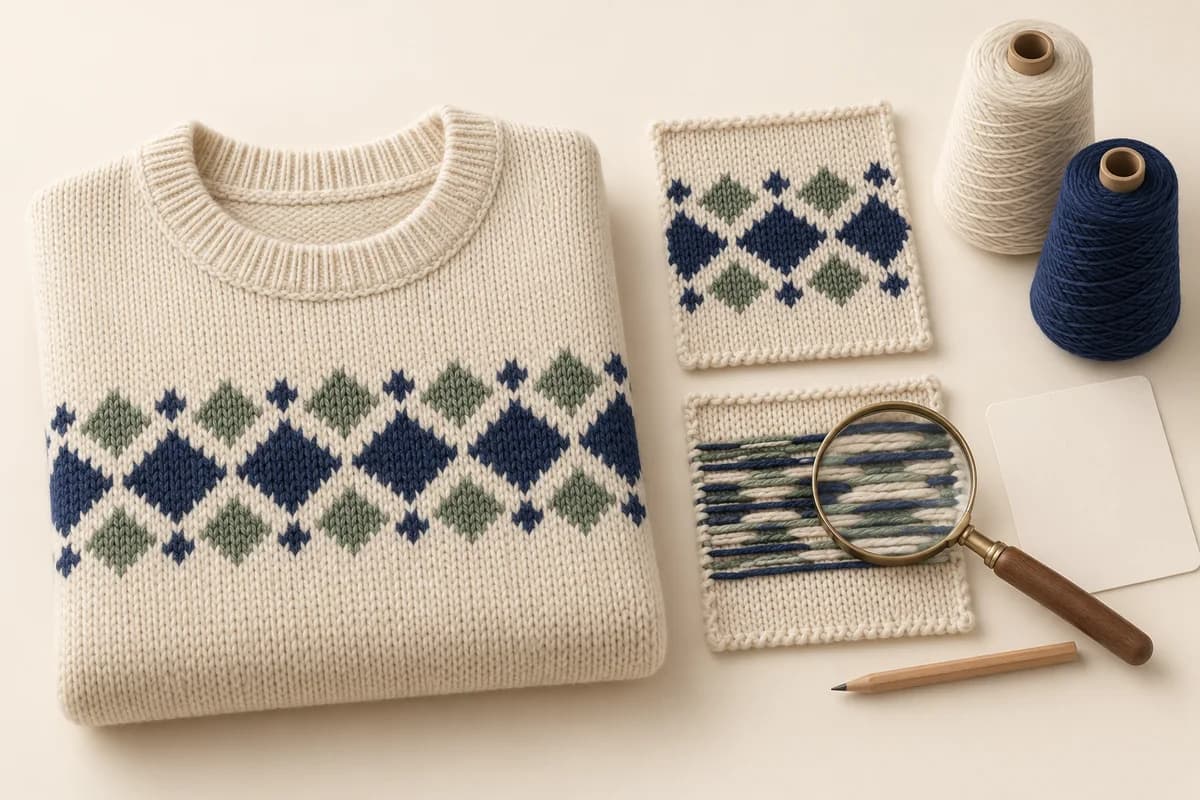
Specify the inside of the sweater in the quotation brief
A brand importing a patterned sweater may approve the motif yet leave the reverse construction undefined. Ask the supplier to identify the proposed jacquard structure and show the inside as well as the face. State the intended wearer, whether the garment is worn against skin or over another layer, and any areas where fingers, jewellery or fasteners could contact carried yarns. Include the artwork revision, motif dimensions, yarn specification, gauge, colourways and quantity per style and colour. Ask what programming, knit trials, finishing and sample charges the offer includes; the same front image does not guarantee equivalent fabric construction or cost.
Review a knitted front-and-back trial, not just a rendering
Request an identifiable swatch knitted with the proposed yarn, gauge and construction, then review the finished garment after the intended finishing. A float is a carried yarn on the reverse; not every jacquard uses the same reverse structure. STOLL’s float-jacquard guidance describes a single-bed fabric and tying in longer floats with tuck stitches. Treat that as technical context for the construction being discussed, not a universal acceptance rule for all sweater designs. Ask the supplier to explain the proposed reverse and any changes needed to make the motif workable.
- Keep front and reverse images linked to the same physical sample, yarn and program revision.
- Review motif edges, open areas and colour transitions; show the reverse with a scale where measurements are needed.
- If an alternative structure is proposed, compare its finished appearance, thickness, stretch and quotation before approval.
Write a practical reverse-side approval record
Agree what will be measured or observed, where the check takes place and what result requires review. If exposed float length is controlled, define the measurement points, the relaxed or extended state and the agreed limit for that construction. Record both the longest relevant span and its location rather than a single unlocated number. Also agree how yarn ends are secured and finished. The table is a buyer planning checklist, not a testing standard, a WTBF inspection record or a universal set of limits.
| Review area | Record with the sample | Decision before production |
|---|---|---|
| Reverse construction | Identified structure and front/reverse reference | Accept the proposed structure or request another trial |
| Exposed carried yarns | Location, measurement method and observed spans | Agree limits and action for an exception |
| Stretch and dressing | Garment size, trial procedure and observations | Resolve restriction or catching concerns |
| Finishing and care | Finishing revision and agreed care trial results | Approve the finished reference or revise it |
Check the finished garment during dressing and agreed care trials
A flat swatch cannot show every interaction at cuffs, armholes, seams or neckline openings. On finished samples in the agreed sizes, review putting on and removing the garment, movement and contact with the intended underlayer. Record where yarns catch, where the knit restricts movement, or where the reverse feels unacceptable for the intended use. Agree a repeatable handling procedure rather than pulling floats arbitrarily. Review the garment again after the agreed care treatment for pattern distortion, exposed yarn changes, dimensions and feel. These development observations are not a claim that a standard snagging or durability test has been performed; specify any required laboratory test and acceptance separately.
Freeze the approved structure and review production changes
Keep the signed or otherwise traceable approval, physical garment, front/reverse images, yarn reference and knitting-program revision together. Specify who may authorise changes to yarn, gauge, motif scale, tie-in arrangement or finishing. A change that improves the reverse may alter the visible pattern or hand feel, so review both sides again. For bulk checks, agree selection across relevant sizes, colourways and production batches, the check points and how exceptions are held and resolved. Link an observed issue to a garment and batch; do not release held stock merely because its face matches the artwork.
- Retain an approved reference available to both buyer and production team.
- Identify changed samples clearly and withdraw superseded instructions from active production.
- Confirm any revised material requirement, unit price and production schedule before authorising the change.
Send a complete jacquard brief with your bulk inquiry
Send WTBF the motif artwork or reference garment, desired front and reverse appearance, yarn priorities, size range and quantity by style and colour. Include the delivery country, target arrival date, wear expectations and required sample or test approvals. Identify which features are fixed and where you welcome a proposed construction. Ask for the sample route, quotation scope and capacity-based production schedule together. Final feasibility, per-style and per-colour quantities, materials and dates need confirmation for the order; dispatch and destination arrival are separate milestones. Use the bulk inquiry to agree the physical approval reference before committing the design to production.
Questions about this guide
Does approving the jacquard artwork approve the reverse side?
No. Identify and approve the proposed reverse construction on knitted material and the finished sample. Keep the reference and acceptance requirements with the same specification revision.
Is one float-length limit suitable for every jacquard sweater?
Do not assume a universal limit. Agree requirements for the actual construction, yarn, garment use and checking method, and review a physical sample. A machine supplier’s technical example is not automatically the buyer’s order specification.