
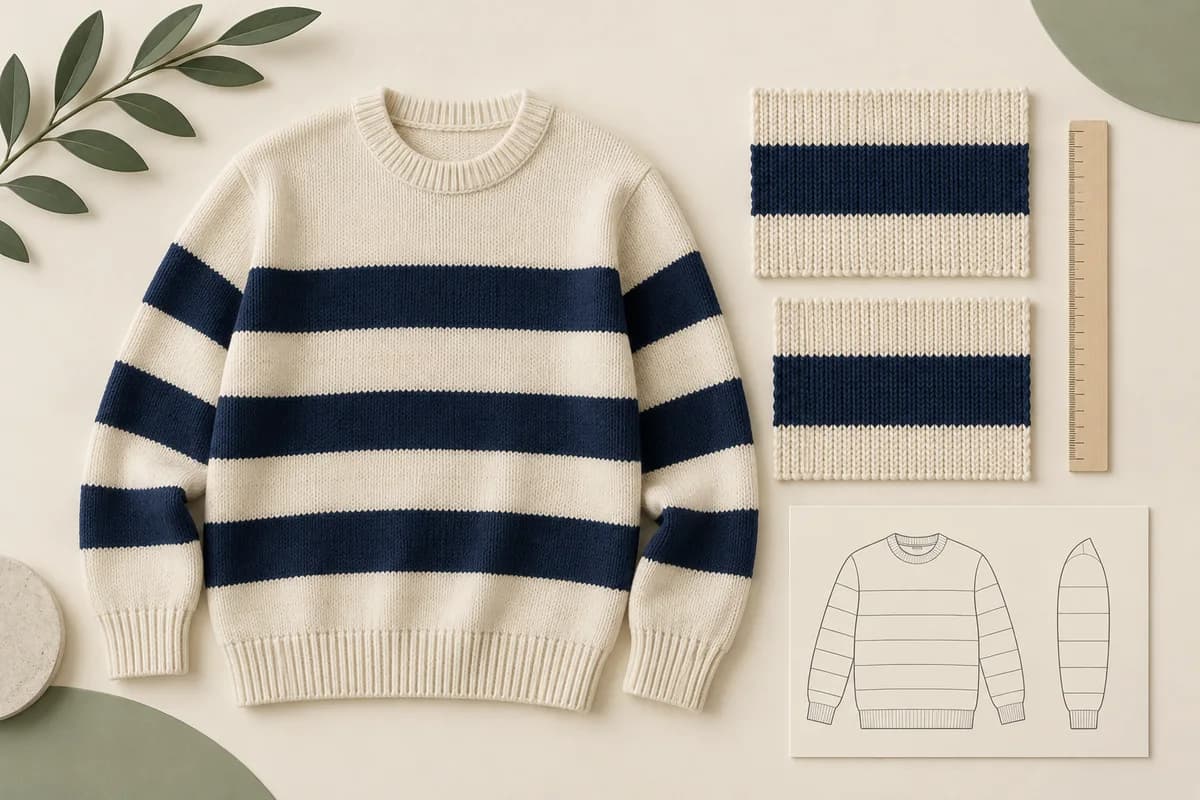
Start with the finished appearance the buyer needs
A brand buying striped sweaters for a coordinated collection needs a repeatable appearance, not just the right two yarn colours. Specify horizontal stripes, colour blocks or another pattern and identify the garment views that matter. Agree whether the design must remain visually consistent across sizes or follow a measured placement rule. Ask the factory to assess feasibility before accepting the production specification.
- Provide front, back and sleeve views with named colour references and a clear stripe sequence.
- Identify the base size, finished measurements and approved finishing process.
- Mark the seams where stripe boundaries must match; do not use “all stripes aligned” as the only instruction.
Use garment landmarks instead of an unscaled image
Choose stable reference points on the finished garment: for example, the top of the shoulder, the neckline edge or the bottom of the ribbed hem. State where each measurement starts and whether the rib is included. Define stripe width, repeat length and the first colour at the chosen landmark. A photo helps communicate appearance but does not establish dimensions or an acceptance limit.
| Feature | Instruction to agree | Approval evidence |
|---|---|---|
| Body stripes | Colour order, stripe widths and starting landmark | Front and back finished samples |
| Sleeve stripes | Starting position and intended relation to body | Garment laid flat plus worn view |
| Side seams | Named boundaries to align and permitted difference | Close view with agreed measuring method |
Choose a stripe rule for the full size range
Increasing body length can add a repeat, change the last stripe or require a different position. Increasing sleeve length creates a separate decision. Agree the rule before preparing size samples: keep stripe widths fixed and allow the ending to vary, keep a key boundary at a defined landmark, or develop size-specific placement. These options produce different appearances and may change programming, material use and cost.
- For a hypothetical S to XL range, review the shortest and longest sizes as well as the base size. This is an approval example, not a required sample count.
- Record whether each size ends with the same colour and how incomplete repeats are handled.
- If body and sleeve boundaries cannot match in every view, choose the priority view and approve the compromise explicitly.
Assess panel assembly and finishing before release
Review stripe continuity at side seams, sleeve seams and armholes on an assembled garment. A curved armhole and shaped sleeve are different from two straight panel edges; specify which junctions matter to the design. Check the appearance after the agreed finishing process, under the same measuring conditions used for approval. Keep yarn identity and colour approval linked to the pattern specification.
- Ask for close views of the named junctions and a full front and back view of the finished sample.
- Agree a measurable acceptance limit for each required alignment and the method used to assess it. There is no universal limit supplied by this guide.
- Review the effect of a changed yarn, knit construction, measurement or finishing process before reusing the approval.
Put the approval into the production and inspection brief
Release one controlled specification containing the pattern revision, colour references, size rule, approved sample identity and seam criteria. An approved yarn colour or flat panel alone does not approve the assembled pattern. Require unresolved exceptions to be recorded before production release. During inspection, check the agreed sizes and junctions against that revision rather than comparing every garment only with the base-size photo.
- Keep measurement accuracy, shade approval and stripe alignment as separate checks. Passing one does not settle the others.
- Identify affected sizes, colours and production lots when a mismatch is found; hold the affected goods pending a decision.
- Confirm whether a correction requires a new sample and whether it changes the price, material plan or shipment schedule.
Send a quotation brief that includes the pattern decisions
To discuss a striped pullover or cardigan with WTBF, send the design views, yarn preference, size range, quantity per style and colour, stripe rule and named alignment priorities. Include your destination and required arrival date. If a detail is undecided, ask for a feasible alternative and its effect on appearance, price and approval work. Bulk scheduling depends on available capacity and confirmed materials and approvals; shipment from the factory is not arrival at destination.
- Use the bulk inquiry entry below and attach the current specification when exchanging project details.
- Request confirmation of sample scope, acceptance criteria and production schedule before committing to the order.
Questions about this guide
Can one medium-size sample approve all stripe positions?
Only if the agreed specification also defines the size rule and the buyer accepts the evidence for the remaining range. Ask for additional size evidence where length or shaping changes the pattern.
Must the sleeve stripes match the body everywhere?
Agree the required junctions and priority view for the actual construction. Review an assembled finished garment and record any accepted exception before bulk production.