
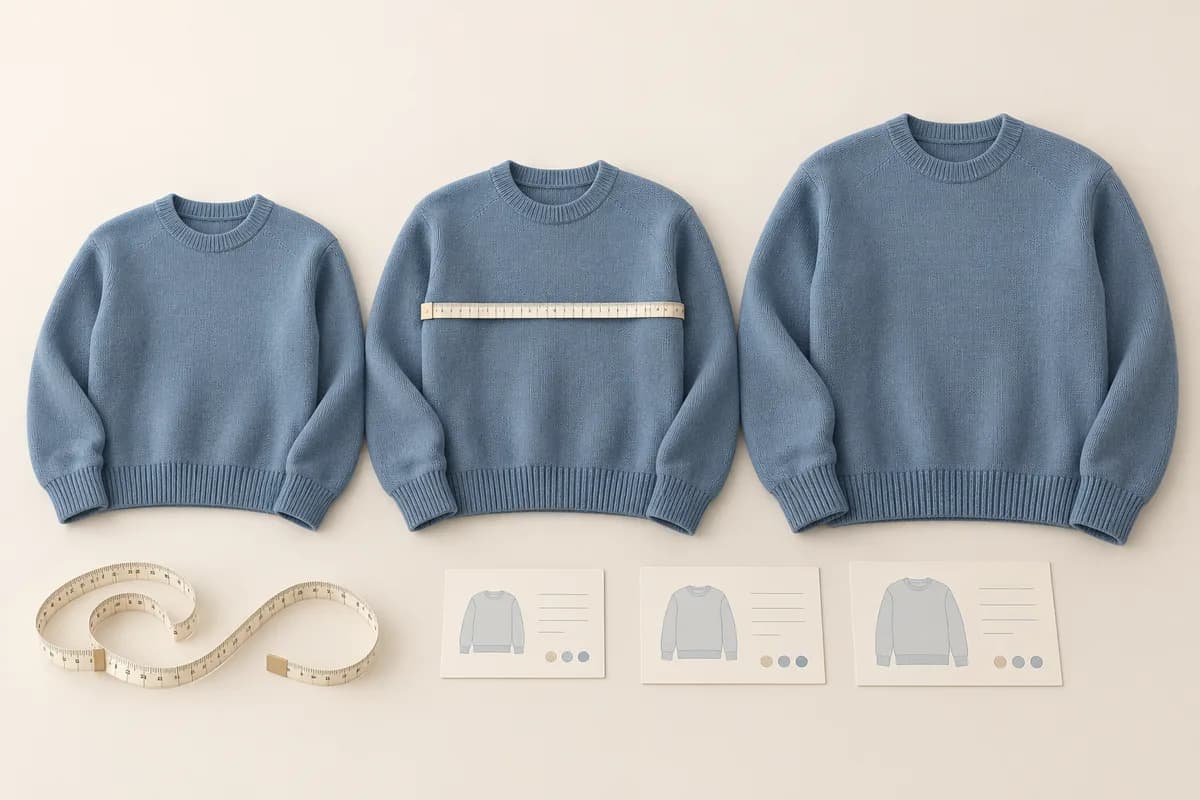
The direct answer: approve a size range, not only a middle-size sample
For a bulk sweater order, approve a versioned measurement chart for every ordered size and a size-set review plan before releasing the affected bulk knitting. A good middle-size fit does not demonstrate that the smallest and largest garments fit correctly. Define how each point is measured, how it changes between sizes, its permitted deviation and the garment state used for review. Match measured results to a physical fit review and record who can approve corrections. This is especially useful for brands, wholesalers and importers expanding a repeat style into a wider size range or introducing a new fit block.
Define measurement points that both buyer and factory can repeat
Give each point of measure (POM) an identifier, a diagram, exact endpoints and a unit. State whether a width is measured flat or as a circumference. For chest width, identify the position below the armhole rather than leaving it to the person holding the tape. Specify the garment closure, lay-flat method, whether rib is relaxed or stretched and the agreed finishing and resting conditions. Do not mix a body measurement chart with finished-garment measurements: the buyer must define the intended fit and ease. Use the same method on the approval sample and bulk garments.
| Point | Definition to agree | Common ambiguity to remove |
|---|---|---|
| Chest | Flat width at a specified distance below the armhole | Flat width versus full circumference |
| Body length | Named starting point to named hem edge | High shoulder point versus centre back |
| Sleeve length | Shoulder seam to cuff, or a defined neck-based route | Different methods for set-in and raglan sleeves |
| Hem or cuff | Relaxed width and, if required, a separate stretched check | Unspecified pulling force or rib state |
Grade each measurement for the intended fit
Write the target measurement for every size, with a separate grade increment for each point. Chest, length, sleeve, neck opening and armhole do not have to increase by the same amount. Do not scale a middle-size sweater by one percentage and assume all proportions will work. Ask how changes in stitch repeats, shaping, rib construction and assembly will implement the chart. Keep the buyer-facing targets explicit even when the factory uses different production instructions. Where the ordered range uses different fit blocks, define the boundary and review both sides. A size label alone does not establish an international fit standard.
Agree which sizes and material combinations need physical approval
List the size-set samples, their yarn and construction, the required finish, review owner and approval deadline. For an unfamiliar or extended range, discuss physical coverage of every ordered size. If the buyer accepts a reduced set, name the included sizes and the evidence required for the others; do not silently treat a middle-size approval as approval of the whole range. Include boundary sizes and high-risk details such as a tight neck opening or short sleeve. Colour or yarn variants with a different construction or finishing route may need separate checks. Record which samples are development trials and which represent the agreed bulk specification.
Keep grading targets separate from production tolerances
A grade increment is the planned difference between size targets. A tolerance is the allowed deviation around one target for an individual measurement; it is not extra freedom to change the grade. The following flat-chest example is hypothetical, in centimetres, and is neither a WTBF specification nor a recommended tolerance. With an illustrative agreed tolerance of ±1.0 cm, S and M are within the measurement limit and L is outside it. Averaging the three results would conceal the L problem. Passing this one measurement does not establish fit approval or acceptance of the rest of the garment.
| Size | Target (cm) | Measured (cm) | Deviation / result |
|---|---|---|---|
| S | 50.0 | 50.7 | +0.7 / within limit |
| M | 52.0 | 52.3 | +0.3 / within limit |
| L | 54.0 | 55.2 | +1.2 / outside limit |
Separate finished-garment measurements from after-care checks
State whether the approved chart applies to the finished garment before consumer care, after a defined care treatment, or both. For after-care review, agree the treatment, number of cycles, drying route, measurement procedure and acceptance limits with the buyer and, where needed, the testing provider. Keep the same identified sample and separate before/after results; do not turn a shrinkage allowance into an undocumented change to the shipped size. ISO 3759 describes preparation, marking and measurement for dimensional-change testing of textiles, including knitted articles. Its public scope does not prescribe a universal sweater fit tolerance. A routine size-set review is not evidence that a standard test has been performed.
Release one approved revision and control corrections
Retain the approved size-set samples, measurement results, fit comments and final chart under the same style and revision. Confirm that bulk instructions use this revision before production. For an out-of-limit result, identify the affected size and point, investigate the cause, correct the sample and obtain the required reapproval. Do not widen a tolerance to make a failed sample pass without the buyer explicitly accepting the new requirement. If the yarn, knit structure, finish or fit changes, agree which sizes must be checked again and what work is held. During bulk production, compare early finished pieces across the agreed size coverage; a late inspection alone leaves less time to correct a systematic sizing issue.
Send WTBF a size-set brief with the bulk inquiry
Send your sweater reference or tech pack, intended wearer and fit direction, complete size range, measurement diagrams, per-point targets and tolerances, and quantities by style, colour and size. Include yarn and finishing requirements, requested size-set coverage, any after-care review, approval contacts, destination and required receipt window. Ask WTBF to confirm sample scope, feasibility, revision control, costs and an order-specific production schedule. WTBF accepts 1,000–1,000,000-piece bulk projects and retains the 50–100-piece small-order route. Final timing follows the confirmed materials, approvals and capacity plan; approval of one sample is not a promise that bulk delivery can begin immediately.
- Versioned finished-garment measurement chart and POM diagrams.
- Explicit grade targets, per-point tolerances and fit priorities.
- Named physical sample coverage and before/after-care requirements.
- Quantity matrix, decision owner and required receipt window.