
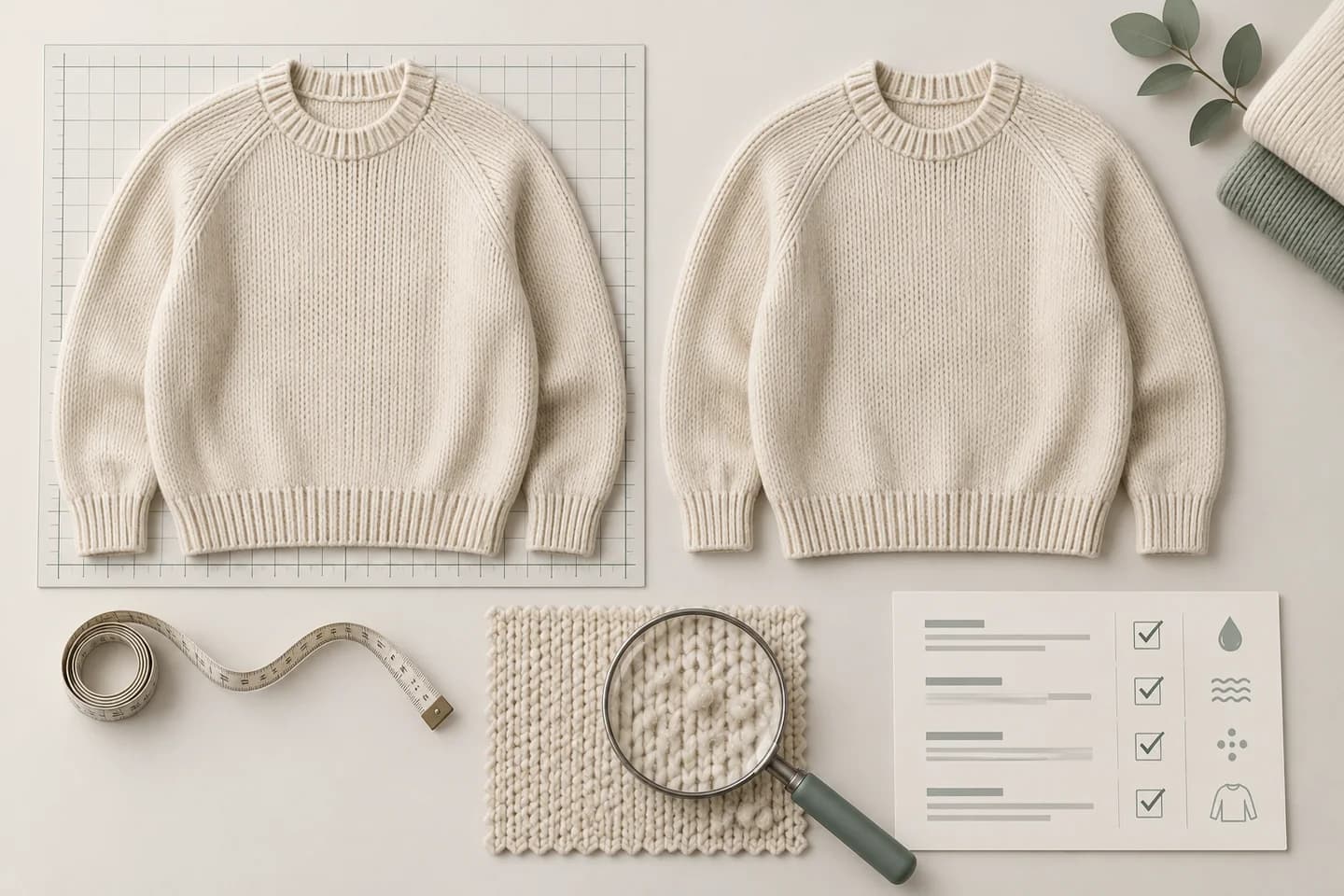
Start with a test brief that can support a decision
For brands, wholesalers and importers, “wash tested” is incomplete without the conditions and acceptance criteria. Record the style and specification revision, yarn and colour reference, sample stage, intended care instructions and tests requested. Decide who reviews the evidence and who authorizes production. A fit approval and a performance approval can be separate decisions; resolve both requirements in the order plan.
- Identify whether samples are development garments, pre-production garments or selected bulk units.
- Agree coverage by style, colour, size and material or production batch; do not assume one sample covers an entire collection.
- Separate internal checks from any requested independent laboratory report, and confirm charges and turnaround before release.
Specify the wash and the drying procedure together
ISO 6330:2021 describes domestic washing and drying procedures for textile testing. Its public abstract states that a complete test includes both, and that equipment and detergent choices can affect results. Ask the testing provider to record the selected procedure, number of cycles, drying route and any preparation required by the chosen method. Align the test brief with the proposed care instructions; “washed at the same temperature” alone does not establish comparable testing.
ISO 6330:2021 — Domestic washing and drying procedures for textile testing
Check dimensional change separately from the starting fit
ISO 5077:2007 covers dimensional change after specified washing and drying procedures. Agree which garment measurement points matter, how they are measured and the required conditioning with the testing provider. Keep the before-and-after readings for each point. A garment that meets the initial size chart may still change after care, and an acceptable change percentage does not prove that its original fit was correct.
- Include agreed points such as body length, chest width, sleeve length and rib openings where relevant to the style.
- State accepted shrinkage and growth for each point rather than relying on an undefined overall result.
- Retain sample IDs and the linked wash/dry conditions so later reports can be compared meaningfully.
ISO 5077:2007 — Determination of dimensional change in washing and drying
Agree a separate pilling method and an appearance reference
ISO 12945-2:2020 specifies a modified Martindale method for evaluating fabric pilling, fuzzing and matting. Naming the method does not establish the buyer’s required rating or prove an order has passed. Agree specimen preparation, test exposure and the rating requirement with the testing provider. Separately define the garment appearance checks after care: shape, seam distortion, rib recovery, trim attachment and any observed colour change. Request an appropriate separate colour test if the buyer needs evidence beyond a visual review.
ISO 12945-2:2020 — Modified Martindale pilling, fuzzing and matting method
Use a buyer-approved test and acceptance matrix
The following is a planning template, not a laboratory procedure or a set of default pass limits. Complete it with the buyer and testing provider before sampling is evaluated. If a requirement is undecided, record that it is pending rather than treating the sample as approved.
| Check | Conditions and coverage to record | Acceptance and evidence to agree |
|---|---|---|
| Sample identity | Style, specification revision, yarn/colour reference, sample stage and IDs | Which styles, sizes, colours and batches the evidence covers |
| Wash and dry | Method/version, selected procedure, cycles, drying route and proposed care instructions | Recorded conditions and report format; resolve any mismatch with intended care |
| Dimensional change | Measurement points, measurement/conditioning procedure and before/after readings | Shrinkage and growth limits per point, agreed before testing |
| Pilling, fuzzing and matting | Separate method/version, specimen preparation and exposure | Required rating and assessment conditions confirmed with the testing provider |
| Garment appearance | Shape, seams, ribs, trims and colour observations against the agreed reference | Named unacceptable changes and dated comparison images or report |
| Failure and retest | Affected specification or batch, proposed correction and replacement sample IDs | Who approves the correction, what must be retested and who authorizes release |
Read the result without inventing a pass limit
Illustrative calculation only, not a WTBF test result or a customer order: if a recorded garment length is 60.0 cm before care and 58.8 cm afterwards, the change is (58.8 − 60.0) ÷ 60.0 × 100 = −2.0%. The negative sign indicates shrinkage in this example. Whether that result passes depends on the previously agreed limit for that measurement point and the specified testing conditions. It says nothing by itself about pilling, colour, other dimensions or the remaining production units.
Resolve failures, then confirm production release
If a result misses the agreed requirement, identify the affected material, finishing process, construction or care proposal before deciding a correction. Changing yarn, knit structure, finishing or care conditions can change the product and may require a new fit review, performance testing, quotation or schedule. Agree the scope of retesting and retain the original and revised evidence. Passing a corrected sample does not automatically release every colour or batch.
- Record the issue, affected sample IDs, proposed correction and specification revision.
- Agree who pays for additional samples and testing, and the effect on production milestones.
- Document the buyer’s acceptance and the styles or batches authorized for production.
Send WTBF the requirements needed to plan the order
For a bulk quotation, send the tech pack or reference, yarn priorities, quantities by style/colour/size, care proposal, test matrix, report requirements and destination deadline. Ask WTBF to confirm the feasible sample and testing arrangements before production timing is committed. WTBF accepts 1,000–1,000,000 piece bulk projects and 50–100 piece small orders; material availability, approvals and capacity determine the final schedule. Testing and retesting need time in that plan, and are not covered by a blanket fast-dispatch promise.
Questions about this guide
What shrinkage percentage is acceptable for bulk sweaters?
There is no single limit suitable for every sweater. Agree limits for each measurement point against the intended fit, yarn, construction and care conditions before testing. State whether the limit covers shrinkage, growth or both; this guide does not prescribe a universal pass percentage.
Does a sweater wash test also prove pilling resistance?
No. A wash review can record surface changes, but a specified pilling test evaluates a separate property under its own conditions. Agree the pilling method, specimen preparation, exposure and rating requirement with the buyer and testing provider.
Can a yarn or swatch report replace a finished-sweater test?
Only if the buyer’s agreed test plan explicitly accepts that evidence for the stated purpose. A yarn or swatch does not represent every finished-garment detail, including fit, seams, trims and care labels. Identify what was tested and which styles, colours or batches the report covers.
Does WTBF include laboratory testing in every order?
Testing is not automatically included in every quotation. Send the required methods, coverage, report needs and deadline so arrangements, sample quantities, charges and timing can be agreed. This page does not claim an existing laboratory report or test certification for your product.