
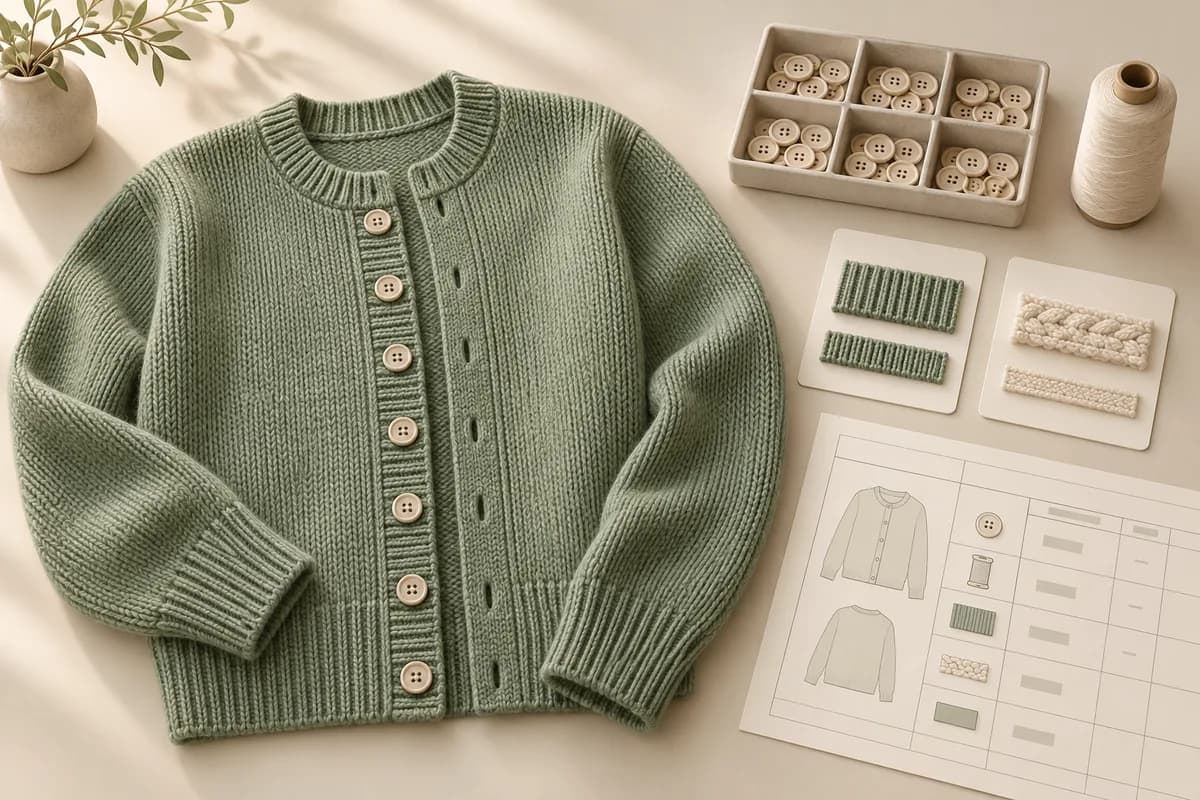
Release a trim plan alongside the garment order
For a bulk cardigan order, approve a versioned bill of materials (BOM) that connects every garment SKU to its exact buttons, sewing thread, reinforcement and other specified trims. Calculate demand from the confirmed style, colour and size quantities; add separately agreed production allowances and customer spares; then deduct only approved, usable stock. Name who purchases each item and when it must be available for attachment. A knit-ready garment can still miss its dispatch window if one essential button is unavailable. A visual reference alone does not define a production-ready trim order.
Specify a reproducible button and trim BOM
Give each component a unique item code and revision. For buttons, record material, diameter, thickness, hole or shank construction, colour and finish, supplier reference, placement and quantity per garment. Identify the physical approval sample and how it is retained. Record sewing thread and any backing or reinforcement separately rather than assuming they are included. If a buyer nominates a trim supplier, agree who places the order, checks deliveries and handles shortages or rejected pieces. A supplier reference is useful only when it identifies the same approved specification.
| BOM field | Buyer and factory decision | Why it matters |
|---|---|---|
| Identity | Item code, revision, supplier reference and approval sample | Avoid a visually similar substitution |
| Application | Applicable style/colour/size SKUs, position and units per garment | Prevent one component being allocated twice |
| Supply | Purchaser, required usable quantity, arrival milestone and reserve owner | Expose a trim shortage before production release |
Check button compatibility on the actual knitted placket
Approve a sewn application using the intended knit structure, placket, buttonhole and thread, with any agreed reinforcement. Check whether the button passes through the hole, closes securely and sits without excessive pulling or distortion. Compare the button weight and thickness with the actual garment rather than choosing by diameter alone. If sizes use different button counts or positions, confirm the relevant size samples. Review appearance and function after the agreed finishing or care process. Define any attachment-strength or other testing method, acceptance level and review party with the buyer before ordering; this guide does not prescribe a universal test or claim that WTBF holds a particular certification.
Calculate base demand, loss allowance and customer spares separately
Use the sum of each SKU quantity multiplied by that SKU’s approved trim usage. In this hypothetical planning example, 8,000 cardigans each require six attached buttons: base demand is 48,000. The buyer separately requests one spare button with each garment, adding 8,000. An illustrative agreed production-loss allowance of 1,600 gives a gross requirement of 57,600. If 2,000 matching approved buttons are confirmed usable and unallocated, the net purchase requirement is 55,600 before supplier pack-size or minimum-order rounding. These figures are arithmetic examples, not WTBF order records or a recommended loss rate. Recalculate when any SKU has a different button count.
| Quantity line | Calculation | Buttons |
|---|---|---|
| Attached buttons | 8,000 × 6 | 48,000 |
| Customer spare buttons | 8,000 × 1 | 8,000 |
| Agreed production-loss allowance | Illustrative separately agreed quantity | 1,600 |
| Gross requirement | 48,000 + 8,000 + 1,600 | 57,600 |
| Approved usable stock | Matching and not allocated elsewhere | −2,000 |
| Net purchase requirement | 57,600 − 2,000, before supplier rounding | 55,600 |
Allocate stock by garment colour and shipment release
A single total can hide shortages in an individual button colour, size or finish. Map each trim item to its garment SKUs and reserve the required quantity for each production or shipment release. Separate received quantity from accepted usable quantity; damaged, incorrect or unapproved pieces cannot cover the order. For a nominated supplier, confirm delivery to the attachment location, incoming review and the time needed to replace rejected trims. Discuss supplier minimums, pack multiples and any surplus ownership before purchase. Use confirmed supply dates to plan attachment and packing; do not assume every trim is available simply because the yarn is ready.
Define approval gates and prohibit silent substitutions
Agree approval of the physical trim, the sewn application and the final BOM before releasing the affected bulk work. Confirm whether an appearance approval also covers function and any required tests; keep unresolved conditions visible. A change of button material, dimensions, finish or supplier can require a new application review and revised cost or timing. Record the change, affected quantities, approval owner and superseded revision. If trims are short, ask for replacement supply, an approved alternative or a clearly identified partial hold. Keep held pieces out of the shipped count and obtain written agreement before changing the garment specification.
Reconcile issued trims, finished garments and remaining stock
At each release, compare accepted receipts, stock issued to production, trims used on completed garments, rejected or lost pieces and returned usable stock. Reconcile customer spares separately and confirm how they are supplied: attached to each garment, placed in an agreed pack or delivered separately. Do not consume customer spares to finish attachment without revising the reserve plan. Identify the owner, storage conditions, retention period and disposal or return terms for surplus materials. Record the approved item and batch with retained stock so a future reorder can be assessed; retained buttons do not guarantee that the rest of the garment specification remains available.
Send WTBF a complete cardigan trim brief
For an order-specific proposal, send the cardigan reference or tech pack, style/colour/size quantities, button specifications or a physical reference, units per SKU, customer-spare requirement and any nominated suppliers. Include the delivery country, required receipt window and approval contacts. Ask WTBF to confirm the BOM, usable-stock assumptions, purchasing responsibility, application review, quoted trim scope and capacity-based schedule. WTBF accepts 1,000–1,000,000-piece bulk projects and retains the 50–100-piece small-order route. Final pricing and lead times depend on the agreed product, materials and order; a trim planning example is not a delivery commitment.
- Confirmed garment SKU matrix and the trim BOM revision.
- Button reference, application positions and units per garment.
- Separate production allowances, customer spares and available stock.
- Purchasing owner, approval requirements and receipt milestones.