
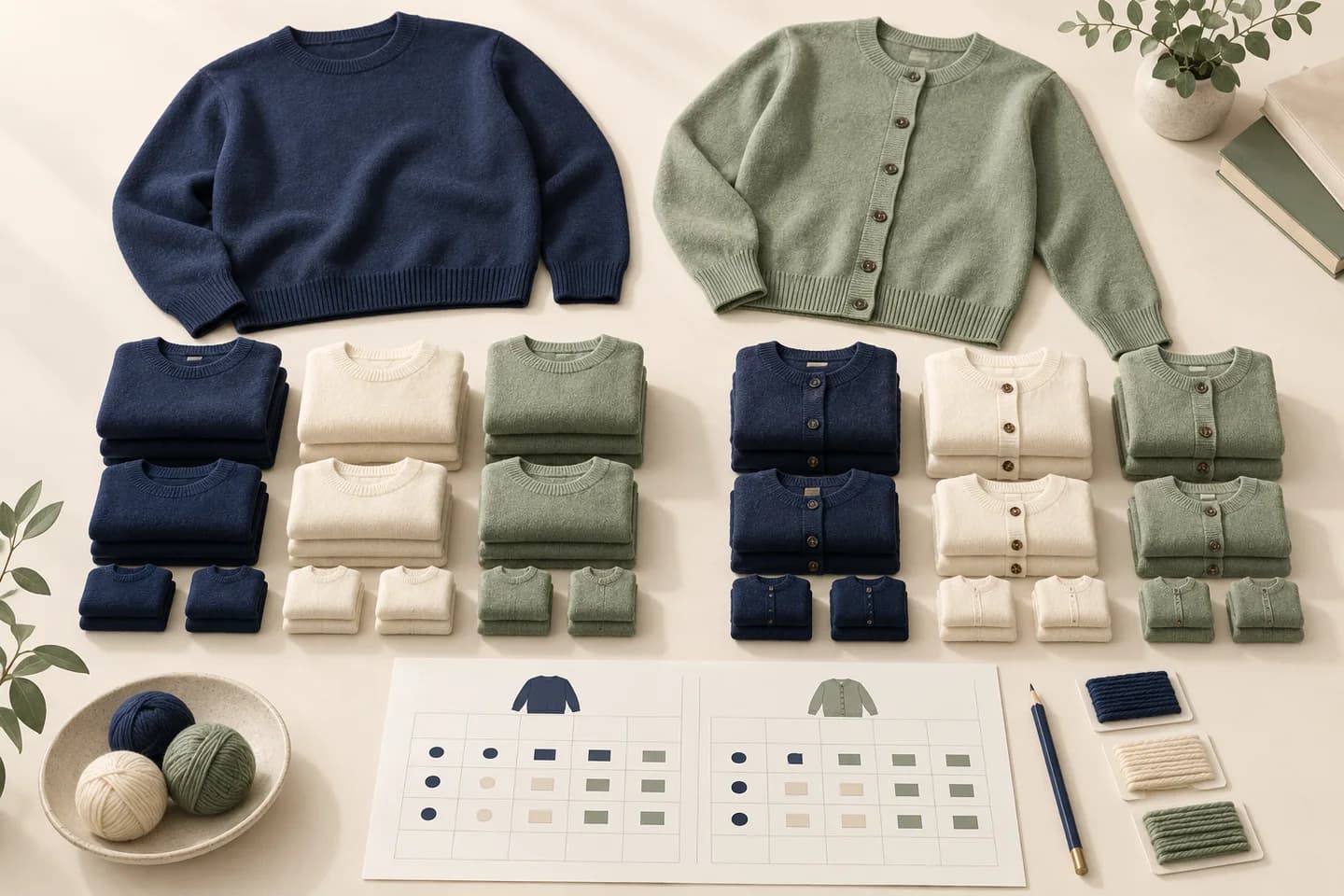
The direct answer: agree quantities at variant level
Before requesting a firm bulk sweater quotation, send one quantity matrix covering every style, colour and size. Each cell should contain an integer garment quantity; the size cells must add up to each colour total, the colour totals to each style total, and the style totals to the purchase-order total. A collection total of 12,000 pieces alone does not tell a manufacturer how much of each yarn colour to plan, which sizes to produce or how to pack the order. Keep the matrix linked to the approved product specification and its revision.
A worked example: two styles, three colours, four sizes
This is a hypothetical planning exercise, not a WTBF customer case, quotation or recommended sales mix. Allocate 6,000 pieces to pullover P01 and 6,000 to cardigan C01. For each style, assign 2,400 navy, 1,800 cream and 1,800 sage pieces. Apply an illustrative size ratio of S 10%, M 30%, L 40% and XL 20% to each colour. Two styles × three colours × four sizes create 24 sellable variants. The six row totals below reconcile to 12,000 garments, with colour totals of navy 4,800, cream 3,600 and sage 3,600 across the collection.
| Style / colour | S · 10% | M · 30% | L · 40% | XL · 20% | Total |
|---|---|---|---|---|---|
| P01 / Navy | 240 | 720 | 960 | 480 | 2,400 |
| P01 / Cream | 180 | 540 | 720 | 360 | 1,800 |
| P01 / Sage | 180 | 540 | 720 | 360 | 1,800 |
| C01 / Navy | 240 | 720 | 960 | 480 | 2,400 |
| C01 / Cream | 180 | 540 | 720 | 360 | 1,800 |
| C01 / Sage | 180 | 540 | 720 | 360 | 1,800 |
| Order total | 1,200 | 3,600 | 4,800 | 2,400 | 12,000 |
Choose the size curve from demand, then round transparently
Use your own comparable sales, pre-orders or retailer allocation requirements to choose the size curve. Review it separately by style, fit, destination and channel: a cardigan and a fitted pullover need not share a ratio. S, M, L and XL are buyer labels; attach each style’s measurement chart rather than assuming the letters define the fit. If data is limited, mark the ratio as provisional and decide who will approve it before the order is released. Convert colour quantity × size percentage into whole garments. Where fractions occur, agree a rounding rule, assign the remaining pieces to specified sizes and recheck the row total. Do not leave percentages as the only production instruction.
Confirm the material and minimum-quantity conditions
Ask the supplier to assess every style-colour row, including the smallest one, before treating the total quantity as feasible. Garment order quantities and yarn or dyeing minimums are different conditions. Sharing a colour name across two styles does not establish that their yarns can be combined: composition, yarn specification, colour reference, knitting requirements and finishing must be reviewed. This matrix is a garment plan, not a yarn purchase calculation; request material planning against the agreed garment specifications and size mix. WTBF accepts 1,000–1,000,000 piece bulk projects and retains a 50–100 piece small-order route. These project ranges do not establish a universal minimum per colour or size.
- Confirm quantity acceptance and price against each style and colour, including any size-specific conditions.
- Ask whether existing yarn colours or custom colour development will be used, and confirm availability.
- Agree responsibility for any surplus material, reservation costs or substitutions before approval.
Map each variant to labels and packing instructions
Give every style-colour-size combination a unique buyer SKU and map it to the approved label artwork. If your retail channel uses GS1 GTINs, GS1 requires a separate identifier for each size and colour combination; repeated units of the same variant use the same assigned identifier. A buyer SKU and a GTIN are different identifiers. Provide your approved identifiers rather than asking production to invent them. Specify whether cartons contain one variant, mixed sizes of one colour, or a defined assortment. Record units per carton, destination and carton markings. If a row does not divide into full cartons, agree a partial-carton plan; do not silently change garment quantities to fit a carton.
Control quantity changes with one approved version
Put the purchase-order number, matrix revision, date, units and approval owner on the order breakdown. Keep sampling approval and quantity approval distinct: an approved medium-size sample does not approve all size quantities or the full measurement chart. Before release, reconcile the matrix with the purchase order, quoted scope, size specification and packing plan. If a buyer moves 200 pieces from navy M to cream L, the collection total stays unchanged but two colour totals, material needs and packing allocations change. Send a replacement matrix, identify the changed cells and obtain written confirmation of any price or schedule impact. Avoid contradictory totals spread across emails.
Keep shipment allocations separate from the full order
For staged deliveries, add a second allocation showing quantities by variant and shipment. Every variant’s shipment allocations must sum to its approved order quantity; each shipment must also have a checked subtotal and packing list. State the destination, requested factory dispatch and required arrival dates separately. Ask the manufacturer to confirm production capacity and materials against the full order, not only the first shipment. WTBF schedules large orders according to capacity; final dates are confirmed per order. A split allocation or a 12,000-piece total does not by itself secure a production slot. Agree any permitted over- or under-delivery at the appropriate variant and order levels rather than relying on a collection-level percentage.
What to send WTBF for a bulk quotation
Send your matrix with product references or a tech pack, yarn direction, measurements, label and packing requirements, destination, target price and currency, and required arrival date. Identify provisional cells and say which decisions must be resolved before production. WTBF can review the breakdown alongside material availability and the production scope, then discuss quotation and scheduling. For a repeat order, send the new variant quantities and reconfirm specifications, yarn availability and capacity instead of assuming the previous mix, price or slot still applies.
- Do all size, colour, style and shipment totals reconcile, with quantities stated in pieces?
- Does every variant reference the correct specification, size chart and buyer SKU?
- Have material conditions, packing remainders and permitted quantity deviations been agreed?
- Is there one approved revision, with a named owner for changes and a confirmed production schedule?