
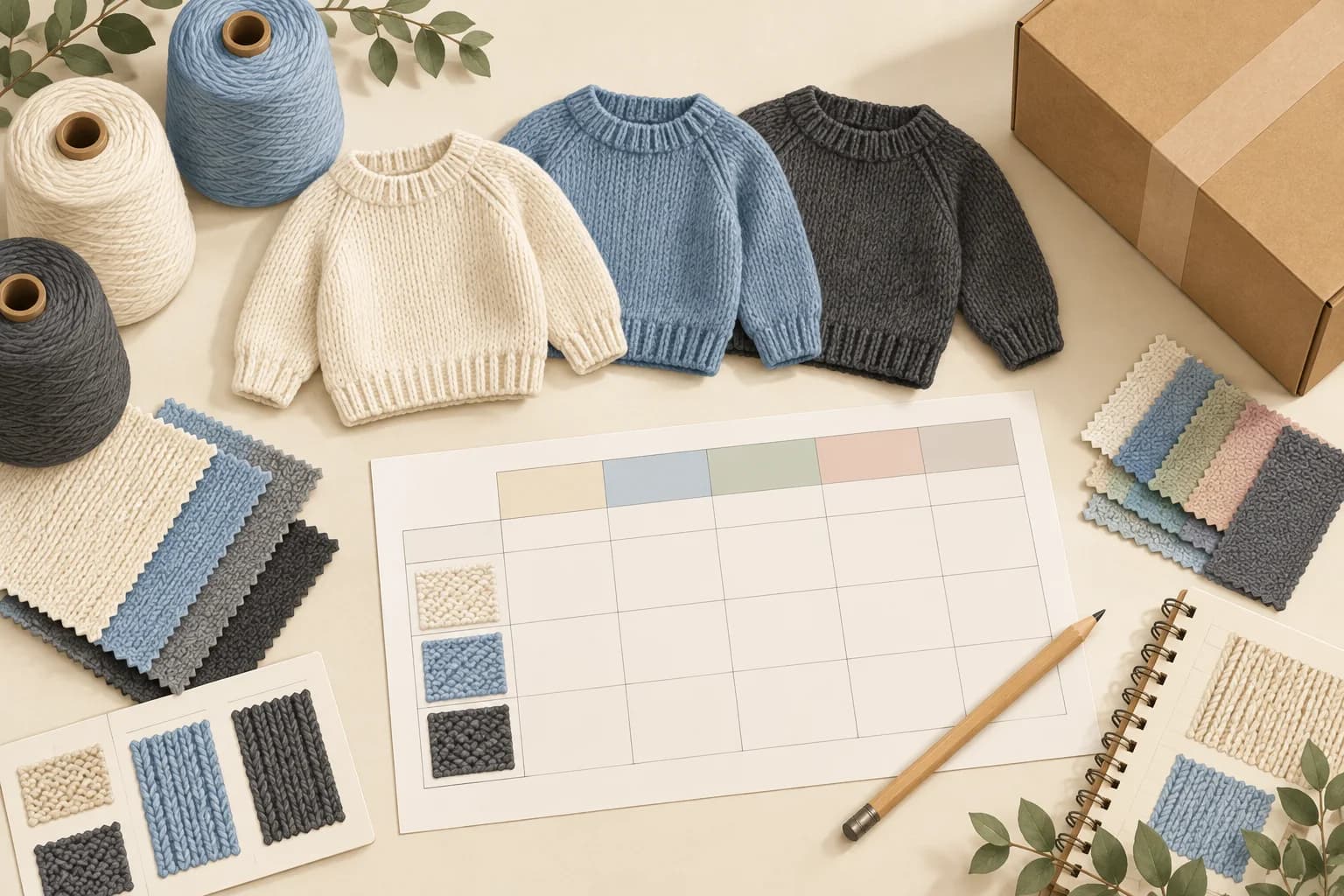
1. Start with an answerable buying brief
An opening message such as “price for 12,000 sweaters?” leaves the supplier to guess the garment, material and assortment. Instead, identify the product category, intended wearer and sales market, attach a reference or link, and state the estimated quantity and delivery country. Describe whether you need manufacture to an existing specification or help developing the product. A clear early brief can start the discussion without pretending every production detail is already approved.
- Product reference: pullover, cardigan or another knitwear category, with front, back and detail views if available.
- Fixed requirements: features that must stay, such as fit direction, essential yarn composition or brand details.
- Open decisions: items on which you want alternatives, such as yarn choice, garment weight or available colours.
2. Show the order split, not just the total
The following is a hypothetical 12,000-piece collection, not a WTBF customer order or confirmed MOQ. It contains two garment specifications and four style-colour combinations. Include the size range and allocation when known; if only a provisional ratio is available, label it provisional. Ask the supplier to confirm material availability and workable quantities against each combination before treating the whole collection as one bulk price.
| Style | Colour | Estimated pieces | Size allocation |
|---|---|---|---|
| Crewneck A | Cream | 4,000 | S–XL; ratio to confirm |
| Crewneck A | Blue | 4,000 | S–XL; ratio to confirm |
| Cardigan B | Cream | 2,000 | S–XL; ratio to confirm |
| Cardigan B | Charcoal | 2,000 | S–XL; ratio to confirm |
| Collection total | 4 style-colour combinations | 12,000 | Not a confirmed production order |
3. Separate material priorities from approved specifications
If yarn is already defined, share the composition, yarn reference, colour standard and available sample. If it is undecided, state the intended handfeel, season, care direction and target price with currency, then ask for alternatives. Include measurements, a size chart or fit reference where available. A photo alone cannot establish fibre composition, garment weight or finished measurements. Ask each proposed option to list its assumptions so changes can be tracked before sampling.
- Mark reference images as appearance references, not proof of material composition.
- State whether labels, buttons, decoration and individual packing are required.
- Identify requested tests or documents; do not assume these are included in a generic unit price.
4. Define the destination and the date you actually need
Provide the receiving country and the required arrival date, with any split-delivery or warehouse requirements. Ask the reply to separate material readiness, sample approval, production completion, inspection and factory dispatch from estimated transit. WTBF assesses bulk projects of 1,000–1,000,000 pieces against available capacity. Annual capacity of one million garments does not establish the current available slot. Three-day sampling and seven-day dispatch apply only to eligible projects after requirements and materials are confirmed; they are not blanket delivery promises.
5. Ask for a reply you can compare
Request a written reply tied to your brief revision. It should identify the proposed specification, assumptions, quantity basis, sample charges, production price and currency, labels and packing included, and costs quoted separately. Ask which approvals are needed before a schedule can be confirmed. If one supplier prices a lighter yarn or simpler packing, treat it as an alternative proposal rather than a direct price comparison. Reconfirm any changed material, quantity or delivery scope before placing an order.
6. Use the checklist to begin your WTBF inquiry
Send the information you already have and mark the rest “to discuss”. The inquiry form includes an editable checklist for your project details and accepts approximate quantities. Reference images and tech packs can be sent to xyzzzlife@gmail.com; the form itself does not upload files. WTBF reviews requirements before discussing pricing, sample costs and a capacity-based schedule. Small projects of 50–100 pieces also remain open for discussion, with materials and each style-colour quantity confirmed separately.
- Yarn or material priorities; colour and size breakdown.
- Reference or tech-pack link, if available.
- Brand labels, trims and packing requirements.
- Delivery country, required arrival date and open questions.
Questions about this guide
What is a knitwear RFQ?
An RFQ, or request for quotation, is a buyer’s brief asking a supplier to price a defined knitwear project. It should identify the product, order breakdown, material and branding requirements, delivery scope and any undecided points. It is not a purchase order or production approval.
Can I request a quote without a complete tech pack?
Yes. Send a product reference, approximate quantity, destination and the material or fit priorities you already know. Mark undecided details clearly. WTBF can discuss development; a final production price and schedule require agreed specifications.
Should I send only my total collection quantity?
Include the total and the quantity per style and colour, plus the size range or proposed size ratio. A 12,000-piece collection split across four style-colour combinations has different material requirements from 12,000 identical sweaters.
What should the supplier reply include?
Ask for the specification and assumptions used, proposed yarn, workable quantity per style and colour, sample charges, unit price and currency, included packing, excluded costs and approval-dependent production and dispatch milestones. Unresolved items should remain visible.