
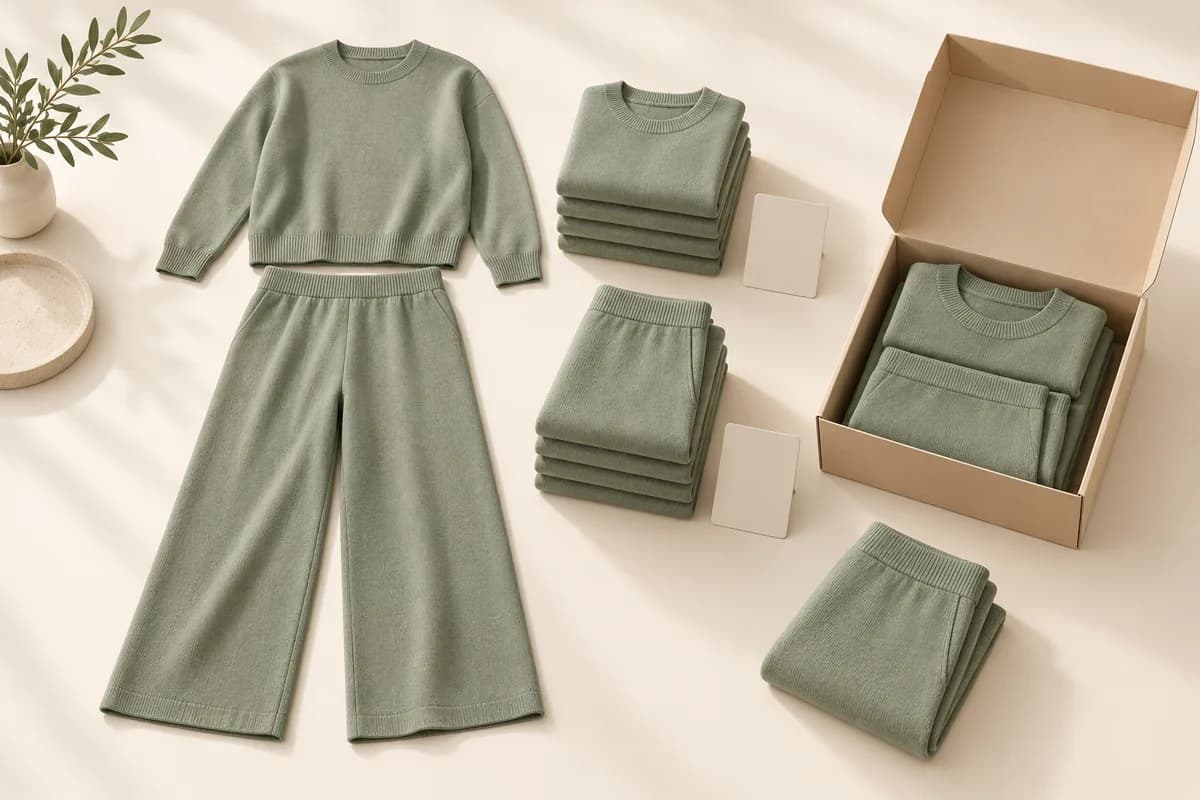
Define the sellable unit before asking for a quotation
A brand or wholesaler may buy coordinated garments as fixed sets, as separate pieces for mix-and-match retail, or through a combination of both. Those are different order structures. For a fixed two-piece set, identify the top style and bottom style, the number of each per set, the colour pairing and the sales unit. Include set assembly and the intended packing scope in the supplier brief so that quotations and production counts use the same basis.
- Write “5,000 sets, each containing one top and one trouser” rather than “5,000 pieces of knit sets.”
- State whether a quoted amount is per set, per top or per bottom, and whether combining the components is included.
- List spare or separately sold components as separate lines; do not silently add them to the finished-set quantity.
Create a pairing matrix, including mixed-size combinations
Give each sellable combination an internal set ID and link it to the component IDs. The hypothetical matrix below describes 5,000 sage sets of the same top and trouser styles. The fourth line intentionally uses a medium top and large bottom. It is a planning example, not a WTBF order, a size recommendation or a retail product identifier. Where components are shared between combinations, allocate them once across all set lines before calculating available sets.
| Set combination | Top requirement | Trouser requirement | Ordered sets |
|---|---|---|---|
| S / S | 1,000 size S tops | 1,000 size S trousers | 1,000 |
| M / M | 1,800 size M tops | 1,800 size M trousers | 1,800 |
| L / L | 1,400 size L tops | 1,400 size L trousers | 1,400 |
| M / L, expressly approved | 800 size M tops | 800 size L trousers | 800 |
| Total | 5,000 tops: S 1,000 / M 2,600 / L 1,400 | 5,000 trousers: S 1,000 / M 1,800 / L 2,200 | 5,000 |
- Repeat the matrix for other colours, style combinations and destination label versions; do not pool incompatible stock.
- Distinguish the set ID from the two component IDs and agree which identifiers appear on each garment and outer set package.
- Check that the component totals equal the demand across every fixed-set and separate-piece order line.
Approve the top and bottom together as well as separately
Review the paired outfit on the intended size combination: proportions, fit relationship, colour coordination and appearance after the agreed finishing or care review. Two garments can meet their individual specifications yet fail the buyer’s intended coordinated look. If the top and bottom use different yarns, structures or finishing routes, agree the visual relationship rather than assuming the same colour name produces an approved pair. Link the paired reference to both component specifications.
- Keep separate measurement and performance requirements for each garment, alongside the buyer’s paired-outfit approval.
- Identify approved colour and material references for both components; discuss how visible variation between them will be assessed.
- Approve the intended folded set, labels and component arrangement before bulk set assembly.
Translate set demand into two production and material plans
Plan yarn, trims, labels, sampling and production for each component using its own confirmed consumption and requirements. A top and a trouser should not be assumed to use equal yarn weights or identical production time. Confirm any separately agreed allowance, extra garment quantities and usable existing stock rather than applying a default percentage. Both component plans must feed the same delivery allocation.
- Quote and reconcile top and bottom requirements separately, even when the buyer receives a single set price.
- Show which yarn or trim stocks are shared and which are reserved for a particular component, colour or release.
- Check the slower component’s approval and production milestones before promising when complete sets can be assembled; capacity and timing require order-specific confirmation.
Count accepted compatible pairs, not just finished pieces
Maintain component counts by set allocation and status: accepted, awaiting decision, rework, rejected or already assigned to another shipment. Only accepted compatible components allocated to the same set line can contribute to ready sets. For one top and one bottom per set, the available pair count is limited by the smaller allocated component count. This calculation is an upper bound until pairing, label and packing checks are complete.
| Status | Tops | Trousers | Implication |
|---|---|---|---|
| Release requirement | 1,000 | 1,000 | 1,000 complete sets needed |
| Accepted and allocated | 960 | 980 | At most 960 pairs before set checks |
| Held outside accepted stock | 40 | 20 | Not available until a release decision |
| After pairing, if all pair checks pass | 960 used | 960 used | 960 ready sets; 40 sets still missing |
| Unpaired accepted balance | 0 | 20 | 20 trousers remain; they are not 20 extra sets |
- Use a separate calculation for every allowed combination; summing all tops and bottoms can hide an assortment shortage.
- Where an M top is shared by M/M and M/L sets, allocate it explicitly so it is not counted as available for both.
- Do not count held or reworked units as ready before the agreed recheck and acceptance.
Agree what happens when only one component is short
Give the buyer a shortage summary by set line, the affected component, its status and the proposed recovery plan. Options may include waiting for approved replacements, shipping a reduced quantity of complete sets, or an expressly authorized separate-component shipment. Each choice changes the buyer’s receiving or selling plan. A partial top shipment must not be described as complete sets, and re-pairing sizes or colours requires an updated approval and allocation.
- State the quantity of complete sets ready now, the unmatched component balance and the remaining complete-set gap separately.
- Confirm revised shipment scope, cost responsibilities and dates before dispatch; dispatch timing does not establish arrival timing.
- Keep any unmatched garments identifiable and agree their use, storage or later reconciliation instead of treating them as fulfilled sets.
Reconcile set assembly with the packing list
At set assembly, check component style, colour, size combination, approved label versions and set identifier against the released matrix. Keep the relationship between the set and its components visible in packing and inventory records. A buyer should be able to reconcile ordered sets, packed sets and the underlying garment pieces without having to guess what the word “quantity” means. The precise packing-list and shipping-document format should be agreed with the buyer and their logistics provider.
- State units explicitly: for example, 960 complete two-piece sets contain 960 tops plus 960 trousers, or 1,920 garment pieces.
- List any authorized unpaired garments separately and state that they are not included in the complete-set count.
- Reconcile each release against the order matrix and remove shipped allocations from available stock before preparing the next release.
Send a set-specific brief for the bulk production discussion
Share the two garment references, yarn and construction preferences, total sets, colour and top–bottom size combinations, any separate-piece demand and delivery country. Include paired-sample approval needs, labels, set packing and intended releases. If combinations or requirements remain undecided, identify those gaps so WTBF can discuss feasibility and the information needed before confirming the quotation and schedule.
- Attach a pairing matrix, or start with the number of sets and the size combinations you know.
- Identify the buyer who approves the paired outfit and any changes to component substitutions or shipment scope.
- Use the bulk inquiry below to discuss the project. Materials, per-style and per-colour quantities, costs and delivery arrangements are confirmed for the order.
Questions about this guide
Does an order for 5,000 two-piece sets mean 5,000 garments?
If each set contains one top and one bottom, 5,000 sets require 10,000 garment pieces before any separately agreed extra units. State the set definition and use separate set and component units in the order and quotation.
Can surplus bottoms make up for missing tops?
No. Count complete sets within each approved style, colour, size combination and label version. A surplus component only becomes useful when a compatible counterpart is available; changing the pairing or selling it separately needs the buyer’s decision.
Must top and bottom sizes always match?
No single pairing rule applies to every collection. The buyer can specify same-size pairs or approved mixed-size combinations. Record each allowed combination and its quantity before production; do not let packing staff invent combinations to consume stock.