
The direct answer: approve packing before the shipment is ready
A bulk sweater packing specification should connect each garment to its carton and each carton to the receiving warehouse. Agree folding, individual packing, the carton assortment rule, units per carton, label artwork, carton numbering and the packing-list format before ordering packaging. Obtain the destination warehouse’s current receiving instructions first. A garment sample approval does not automatically approve packing, and “standard export packing” leaves important decisions open. This guide focuses on warehouse-ready packing for brands, wholesalers and importers; product labelling and destination compliance requirements must be confirmed separately.
Start with the receiving operation, not the carton size
Ask the warehouse whether it receives single-variant cartons, mixed-size cartons or fixed assortment packs, and whether garments are stored individually or as a pack. A single-variant carton contains one style, colour and size; an assortment carton needs a precise contents breakdown. Specify any buyer-required maximum carton weight or dimensions, pallet arrangement, booking information and label template. Record the warehouse contact and the revision date of its instructions. If one order serves several warehouses, assign the packing destination before cartons are filled rather than assuming the same layout will suit every destination.
- Confirm the destination, receiving contact and delivery-booking responsibility.
- Confirm the packing unit, allowed assortment and treatment of incomplete packs.
- Obtain carton, pallet and electronic shipment-information requirements from the actual receiver.
Define one garment’s packing and approve a physical example
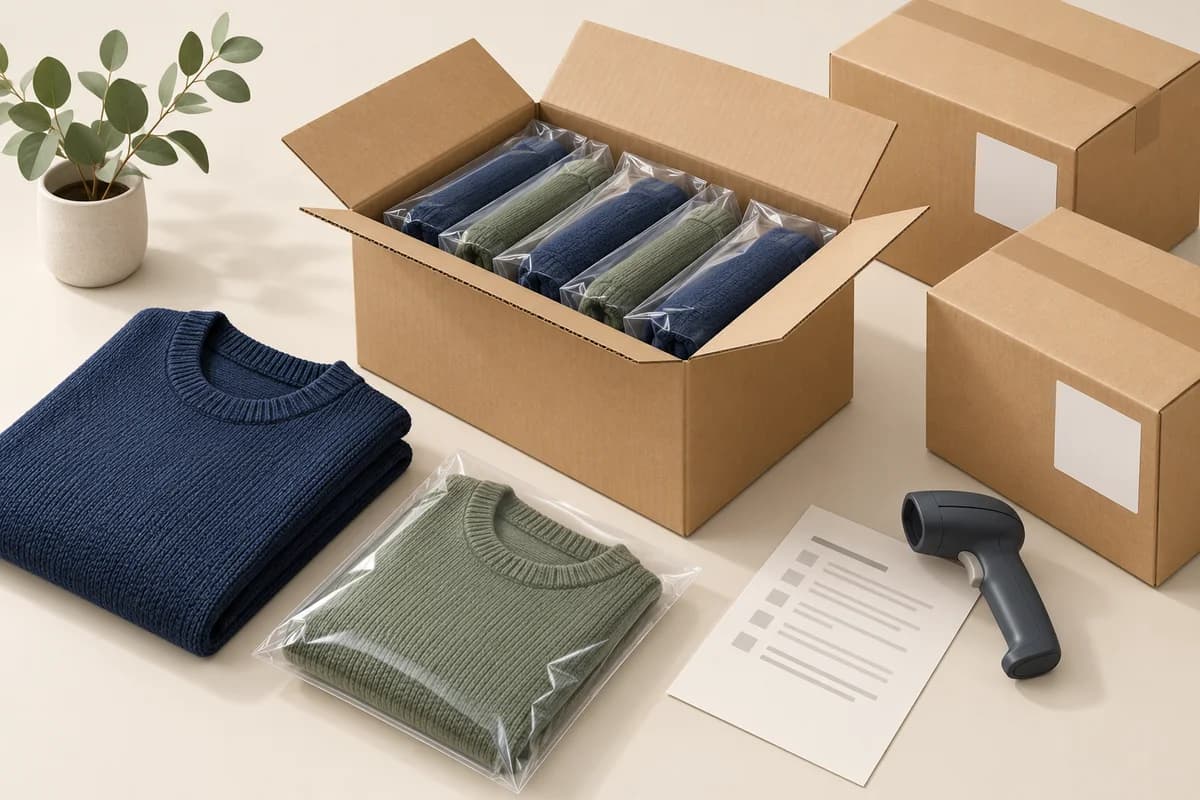
Specify the fold dimensions, orientation, garment sleeve or other agreed protection, label position and any inserts. Consider the actual sweater’s bulk, surface and trims: a heavy cable knit and a lightweight knit may need different folding and carton quantities. Ask for a packed garment and a filled carton example so appearance, compression and unpacking can be reviewed. Do not approve a larger units-per-carton figure solely because it reduces carton count. Agree protection and storage conditions with the factory and logistics partners; no packaging choice by itself guarantees that goods stay dry throughout transport. Material claims, warnings and market-specific packing rules need their own confirmation.
A worked example: make the partial carton visible
This hypothetical example concerns one already-approved style/colour/size variant, not a WTBF shipment record or a recommended carton capacity. Pack 2,408 sweaters at an agreed 24 garments per full carton. That gives 100 full cartons plus one partial carton containing eight garments: 101 cartons in total. Number the cartons consistently within the shipment and identify the partial carton clearly. If the receiver prohibits partial cartons, obtain an approved alternative; do not quietly add garments, omit eight units or mix another variant into the carton. Repeat the calculation for other variants and reconcile their actual packed quantities to the released order.
| Carton numbers | Cartons | Units per carton | Garments |
|---|---|---|---|
| 001–100 | 100 | 24 | 2,400 |
| 101 · Partial | 1 | 8 | 8 |
| Shipment total | 101 | 24 full / 8 partial | 2,408 |
Separate product identity from carton identity
Use the buyer-approved product identifier on the garment or its individual packing. Use the required shipment and carton identifiers on the outer carton. A visible carton-number sequence helps people reconcile a shipment, but it does not replace a receiver-required logistics identifier. GS1 describes the Serial Shipping Container Code (SSCC) as an identifier for logistics units such as cartons, cases or pallets. Where the buyer requires an SSCC, confirm who assigns it, which unit it identifies, the label layout and the related shipment data. Do not invent identifiers or copy one unique logistics identifier across different units. Request approved artwork and check a printed label with the receiving system before bulk printing.
Use measured cartons for the packing list and freight quotation
Agree a packing-list record showing purchase order and shipment reference, carton number or range, destination, style/colour/size contents, quantities, dimensions and net/gross weights. State the measurement units and define what is included in each weight. A range of cartons can share one row only when the contents and relevant measurements are represented accurately; show a partial or mixed carton separately. Measure packed cartons rather than quoting from an empty box or multiplying a sample sweater’s weight alone. Ask the forwarder how actual weight, volume, pallets and other charges affect the quoted service. Its chargeable-weight rules and the receiver’s limits must be checked for the actual route and booking.
Freeze the packing revision and reconcile every dispatch
Keep one approved packing specification tied to the product specification and purchase-order revision. Record approval of folding, individual packing, carton contents and printed labels, together with who may approve a change. If a carton quantity, warehouse or shipment split changes, update the affected records before dispatch. For staged shipments, each dispatch needs its own actual packing list and carton allocation, with the remaining order balance tracked separately. Keep unshipped and packed quantities distinct. Agree how discrepancies, relabelling or repacking are handled and who confirms any resulting cost or schedule change. Photographs can support the review, but should not replace an agreed physical packing check where one is needed.
Send a packing brief with your bulk knitwear inquiry
To discuss packing and a production quotation with WTBF, send the garment reference, approved or proposed quantity breakdown, destination, warehouse instructions and arrival requirement. Attach the label template or describe what still needs approval. State whether you need single-variant cartons, assortment packs or several delivery batches. Ask which packing costs and checks are included and which are quoted separately. WTBF accepts bulk projects of 1,000–1,000,000 garments as well as 50–100 piece small orders. Material availability, packaging requirements and capacity determine the agreed schedule; any eligible fast-track arrangement must be confirmed for the actual project.
- Garment reference, yarn/weight direction and quantity by style, colour and size.
- Folding and individual protection, carton assortment, partial-carton rule and receiver limits.
- Label artwork, identifier responsibilities and packing-list or shipment-data template.
- Delivery country, warehouse destination, required arrival date and any split shipments.