Define the opening and wearing requirement for each location
For a brand buying pullovers, a close-fitting cuff and a gently fitted hem serve different purposes. Identify each rib location and the intended garment size range. Specify whether the cuff must pass over the hand without opening a fastening, and whether the hem should sit close to the body or remain loose. Describe the intended wearer and layering. Agree suitable fit forms or fit participants and the dressing movements to review. Avoid using one instruction such as “tight rib” for every location: it leaves both usability and the visual target unclear.
Keep relaxed size, extension and recovery as separate records
Measure the finished garment in the agreed relaxed condition using identified points and units. State whether an opening is a flat width or a full circumference; do not mix the two in the specification. Next define the extension check, including direction, target opening or specified load, equipment, hold time, repetitions and rest time. Record the result after release against the same reference points. A manually stretched sample without these conditions is a comparison aid, not a repeatable acceptance method. Ask a testing provider to select a suitable laboratory method when quantified elastic performance is required.
| Requirement | Record | Decision |
|---|---|---|
| Relaxed size | Location, size, flat width or circumference and measurement condition | Agreed size tolerance |
| Dressing opening | Opening or load, direction, hold time and repetitions | Usable opening and acceptable appearance |
| After release | Rest time, repeated measurement and visible shape | Agreed retained-size and appearance limits |
| After care | Care procedure, cycles, drying and repeat check | Separate after-care acceptance |
Approve finished garments, including the join to the body
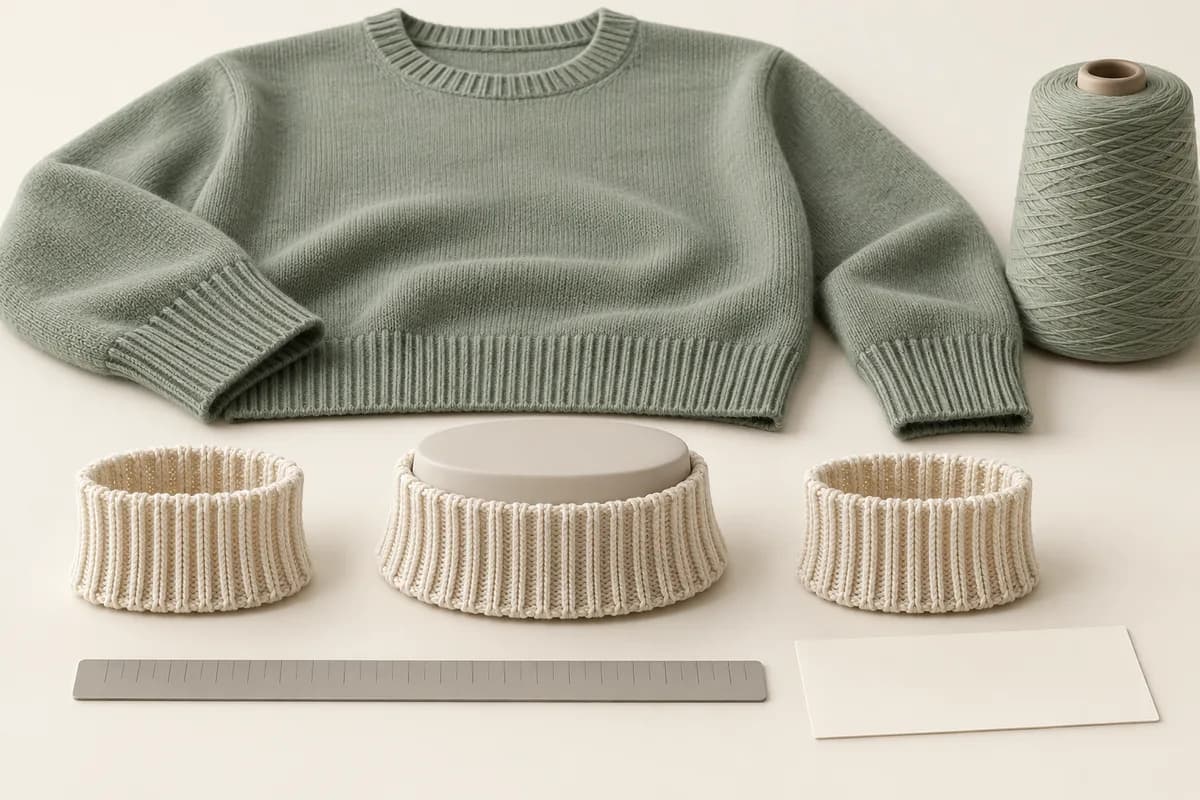
Use samples made with the proposed yarn, rib construction, elastic yarn if specified, joining and finishing route. A loose rib swatch does not approve the opening or the join on an assembled sweater. Check both cuffs together for symmetry, inspect the hem for flaring or excessive draw-in, and look for broken stitches, gaps or distortion after the agreed movements. Review the smallest and largest relevant sizes as well as any colour or material variants that need separate approval. Record which variants the reference covers. Do not assume that adding elastic yarn alone will resolve a poor fit or an unsuitable construction.
Agree care checks and distinguish them from a stretch trial
If recovery after consumer care is required, agree the washing or other care route, drying, number of cycles and measurement condition, then repeat the specified checks. Record initial size, after-care size and after-stretch size separately so shrinkage and residual extension are not hidden in one reading. ISO 20932-1 describes fabric strip or loop tests for elasticity and related properties, excluding narrow fabrics. Its public scope does not set a universal finished-sweater cuff limit. Confirm the applicable part, edition, specimen and method with the testing provider; an informal garment trial does not establish compliance with that standard.
Resolve failures before releasing the approved specification
First identify the failure: an opening that is too small, uncomfortable pressure, a join that restricts extension, or a rib that stays enlarged after release. Ask for a revised sample against that specific problem. Compare changes in rib dimensions, knit construction, yarn or elastic component and finishing, together with their effect on appearance, composition information, cost and timing. Recheck the whole garment after a change. Keep the approved physical reference, measurement record and construction revision linked; require written approval for later substitutions. Do not make cuffs tighter merely to conceal weak recovery.
Use the same checks during production and in the bulk RFQ
Agree the production sampling plan, responsible reviewer, records and action when a result falls outside the approved requirement. Keep checked pieces identifiable by style, colour, size and production lot. Hold affected pieces for a decision and record any correction and recheck instead of averaging a failed cuff into an acceptable batch result. For a WTBF bulk quotation, send the garment reference, rib locations, yarn priorities, size range, quantities by style and colour, proposed opening and recovery requirements, and delivery country through the bulk inquiry form. Ask WTBF to confirm the sample route, testing responsibility, cost scope and a capacity-based schedule. Extra trials can change production release; dispatch and arrival remain separate milestones.
Questions about this guide
Does the correct cuff width prove acceptable recovery?
No. Relaxed width describes the starting size. Dressing extension and the size or appearance after a defined release and rest need separate agreed checks on the finished garment.
What recovery percentage should every sweater meet?
There is no single acceptance percentage for all sweater cuffs and hems. Agree the product use, procedure, measurement basis and limits with the buyer and testing provider before approving the sample.