Define the artwork priorities before asking for a price
A brand planning a graphic sweater collection should send an editable artwork file or a clear image with the intended garment reference. Identify the front, back and sleeve areas, the colour references, the desired motif dimensions and the measurement origin on the garment. Mark the essential features: a recognisable shape, a particular edge or a small detail that cannot disappear. Ask the supplier to identify uncertain details before quoting development. If the brief includes lettering, approve the exact wording and its legibility in a knitted trial; do not assume a clear screen image guarantees readable stitches.
Confirm the proposed construction and its limitations
Ask whether the supplier proposes intarsia alone or a combination of knitting techniques, and request an explanation of the front and reverse construction. STOLL’s technical guide describes individually knitted colour fields and binding at the field edges, and notes that many colours in a knitting row can increase production time on the CMS sequence it describes. This supports checking colour layout and construction together; it is not a production-time estimate or an acceptance specification for your order. Do not assume every colour-block design uses the same process, or that WTBF owns the equipment described in the guide.
Approve a finished knitted trial before the full garment
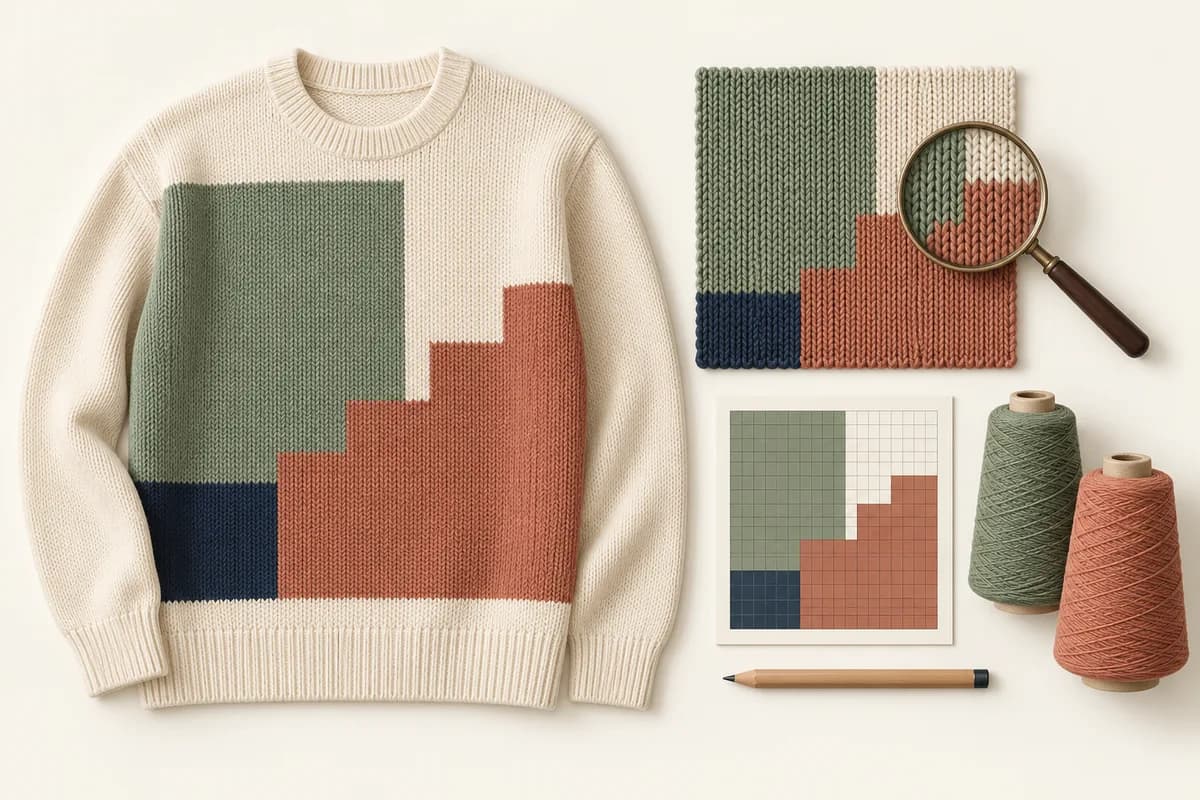
Request a trial that includes the most demanding colour boundary, diagonal edge and smallest important feature, using the proposed yarn, gauge, stitch structure and finishing route. Ask the supplier to show the corresponding stitch chart and the intended finished dimensions. Review the actual knitted shape, colour coverage, boundary joins, holes, puckering and reverse finish. Record any acceptable simplification on a marked image and keep the physical trial reference. A chart is a knitting instruction, not a guarantee that each square will have the same height and width in the finished fabric. Agree any measurement and care checks for the actual material.
| Decision | Reference to keep | Condition to confirm |
|---|---|---|
| Artwork interpretation | Original file and marked knitted version | Which small details may change or disappear |
| Colour boundary | Identified finished trial, front and reverse | Agreed joining appearance and checks |
| Motif dimensions | Measurement points on the finished trial | Garment state and order-specific tolerance |
| Production release | Approved garment and revision reference | Named approver and changes requiring review |
Resolve motif placement for the whole size range
Once the trial is accepted, review the motif on a complete finished garment and on the agreed size-set samples. Decide whether the motif keeps one physical size, scales by garment size, or uses defined groups of sizes. Record its distance from a stable reference such as the centre front, neckline or hem, with the measurement method stated. Check whether armholes, neckline shaping or seams cut into important artwork details on smaller sizes. Review any intended matching across adjoining panels on the assembled garment. A larger sweater does not automatically require a proportionally larger motif, and one approved middle size does not settle every size.
Freeze the approved version and price any revisions
Keep one release reference linking the original artwork, approved stitch chart, colour-to-yarn mapping, finished trial, size placement schedule and approved garment. Ask the supplier to identify any change to yarn, gauge, colour layout, knitting program, joins or finishing that requires buyer review. For a new colourway, confirm the actual yarn references and whether another knitted trial is needed. If the artwork changes after development or material booking, obtain the revised price, material implications and production schedule before authorising the change. Agree the inspection method and acceptance criteria for the identified production lots; a sample approval does not replace bulk checks.
Send a brief that can become a bulk production plan
To discuss an intarsia sweater project with WTBF, send the artwork, garment reference, yarn composition or priorities, motif dimensions, intended size range and quantity by style, colour and size. Add the destination, target arrival date, required approvals and any testing requirements. Ask for feasibility feedback, proposed trials, development charges, production price and an approval-dependent schedule. Large orders must be scheduled against available capacity. Confirm material availability and quantities per style and colour before ordering; a factory dispatch date is different from the date goods arrive. Use the project quotation form to share the information you already have.
Questions about this guide
Can the factory reproduce every detail of a digital graphic in intarsia?
Do not assume so. Ask the supplier to flag uncertain details and propose a knitted interpretation. Approve the physical trial and any simplifications before releasing production.
Should the same motif be enlarged for every sweater size?
There is no single rule. Agree a fixed motif size, scaling or size groups, then approve dimensions and placement on the relevant finished size-set samples.