All articles09

Bulk buying · After-wash twist

After-wash garment twist: approve knitwear alignment before bulk production

When a washed sweater no longer hangs or lies in the intended alignment, agree how garment twist will be observed before releasing bulk production. Identify the finished sample, care route, reference points and decision owner. A shrinkage result or a quick steaming adjustment does not by itself approve post-wash alignment.

By WTBF · Knitwear buying guides

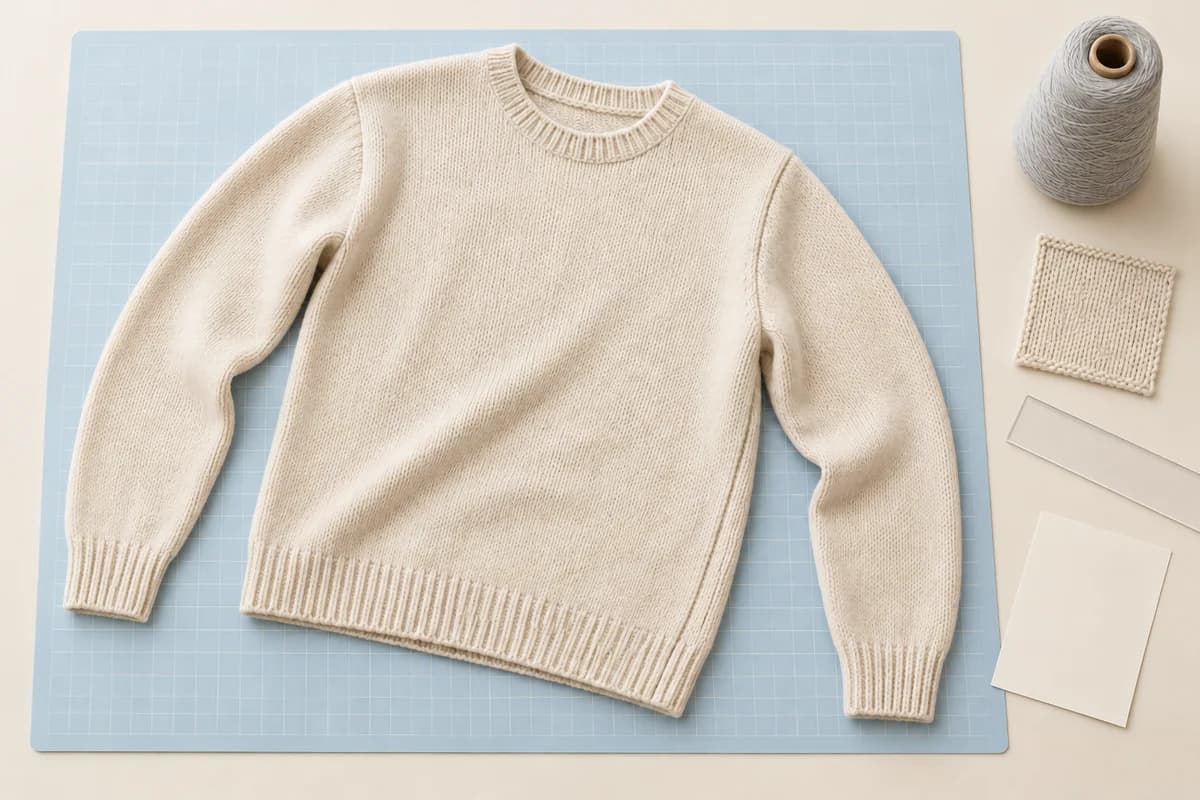
Concept illustration of a cream knitted sweater laid on a pale blue inspection mat beside a yarn cone, knit swatch, plain ruler and blank approval card.

Start with a clear garment-alignment question

For a brand buying a sweater to be worn and displayed with a straight centre front, a washed sample that shifts to one side needs a defined review rather than a vague note to "make it straighter". Identify the garment areas that matter for the style: for example, centre-front line, side seams, shoulder seams, sleeve position, placket or decorative placement. State whether the garment is assessed laid flat, on a form or during wear, and which size and colour are under review. Mark the approved sample or photo reference so both parties compare the same locations. Garment twist is an alignment observation; do not treat an unmarked photograph as a complete requirement.

Keep twist, dimensional change and temporary handling separate

A garment can change width or length after care while its centre and seams remain aligned, and it can look skewed even when a selected width and length measurement remains within the agreed range. Record dimensional change, garment twist, seam appearance and fit as separate observations. Also distinguish a persistent change after the agreed dry-and-condition state from temporary distortion caused by folding, pressing or the way a garment is placed on a table. If an adjustment such as steaming is allowed before the final review, write down the route, equipment and conditioning time; otherwise a later comparison may use a different state from the approved sample.

Agree the care route and assessment method before testing

Use the proposed care instruction and finished construction to define the wash, dry, conditioning and assessment sequence. Record the sample identity, yarn and colour reference, knit specification, finishing revision, number of care cycles, whether fastenings are closed and the positions used for observation. If a buyer needs a named method, give the testing provider the actual product and required decision instead of assuming any laundry test is interchangeable. AATCC lists TM 179 as "Skewness Change in Fabric and Garment Twist Resulting from Automatic Home Laundering". That title helps identify a specific method; it does not set a universal pass limit or confirm that every knitwear order should use it. Confirm the applicable method, edition, sample preparation and report format with the responsible testing provider.

Turn the approval into records people can use

Before production release, name the reference and state the condition that is being accepted. Avoid a generic instruction such as "no twisting" when the buyer actually needs a particular seam position or visual alignment after care. If a numerical tolerance is required, agree its reference points, direction, calculation and who takes the reading. Keep the record alongside the care route and approved product revision, so a later reviewer can see whether the same question was answered.

After-wash garment-twist approval record for a bulk knitwear order
DecisionRecord to retainCondition to confirm
Garment alignmentIdentified finished sample or approved visual referenceRelevant centre, seams or placement points after care
Care and assessment stateWash, dry, conditioning and permitted preparationComparable route before each observation
Bulk coverageStyle, size, colour, yarn and finishing revisionWhich goods the approval covers and which remain open

AATCC — TM 179 listed for skewness change and garment twist after automatic home laundering

Recheck meaningful changes before treating the decision as transferable

A passed sample should be linked to the construction that was actually reviewed. Changes to yarn, stitch density, panel shape, joining, trim weight, finishing route or care instruction can affect how the garment relaxes and aligns. Decide in advance whether the smallest and largest sizes, particular colours or a revised construction need separate samples. If a bulk observation differs from the approved reference, keep the affected goods identifiable and agree a written hold, review or corrective path. Do not silently rely on an earlier sample that was washed under different conditions, and do not use a change in one measurement to explain away a separate alignment issue.

Send WTBF a usable bulk inquiry

For a bulk knitwear quotation, send the garment reference or tech pack, intended care instruction, size range, quantity by style and colour, known alignment concern, proposed review route, destination and required arrival date. Attach an approved sample or photographs that identify the observation points when available, and state who approves any test evidence. Ask WTBF to discuss sample scope, testing responsibility, costs and the production-release point alongside material availability and a capacity-based schedule. WTBF accepts bulk knitwear projects from 1,000 to 1,000,000 pieces; practical quantities, test needs and timing are confirmed for the order. Keep factory dispatch and destination arrival as separate dates.

Questions about this guide

Is after-wash garment twist the same as shrinkage?

No. Shrinkage describes dimensional change, while garment twist concerns alignment after the agreed care and assessment state. Record and approve them as separate requirements.

Can one washed sweater approve every size and colour?

Only if the buyer and supplier explicitly agree the coverage. Identify the style, size, colour, yarn and finishing revision represented by the sample, then name any variants or changes that need separate review.

Discuss your knitwear projectBack to Blog