
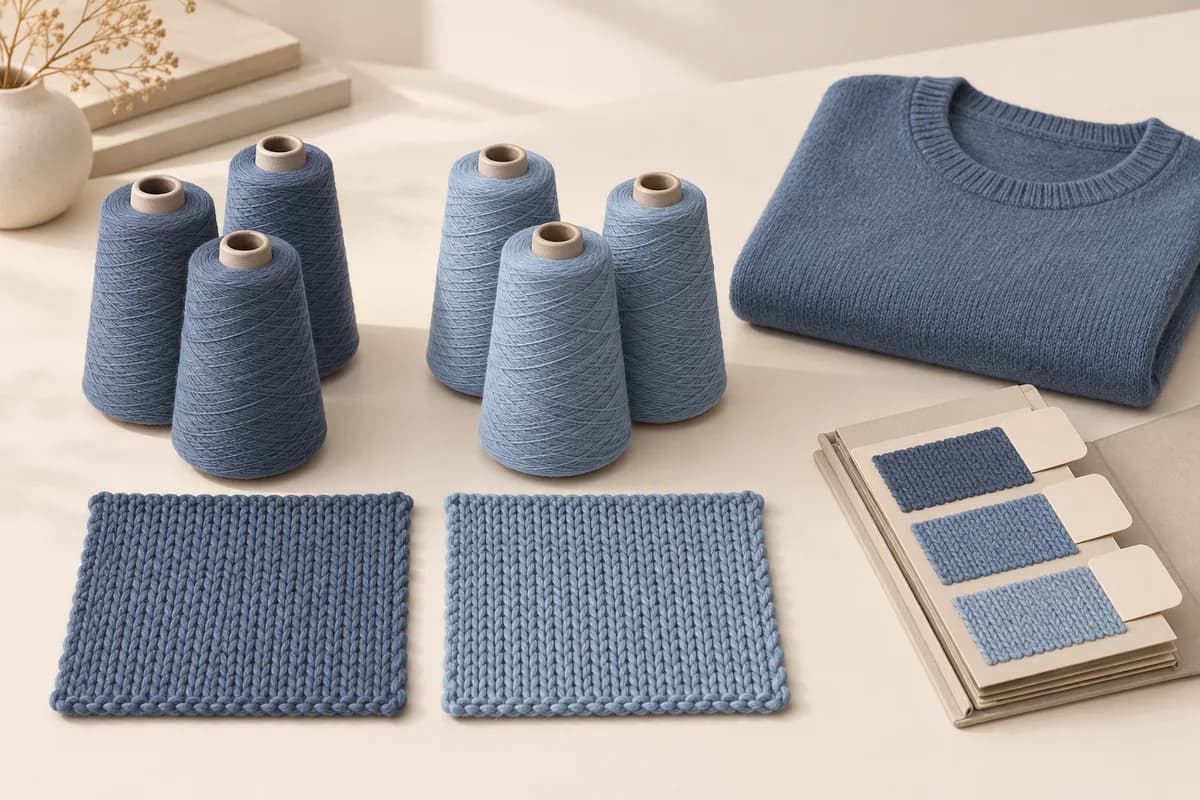
The direct answer: a repeat style still needs a material release
For a bulk sweater reorder, do not treat the old colour name or purchase order as a complete production instruction. Keep the approved physical colour reference, identify the available yarn dye lots, confirm usable stock by colour and approve any new lot on a knitted sample after the intended finishing. Release the repeat order only when the material, shade decision, quantity and schedule are recorded together. This guide is for brands, wholesalers and importers replenishing an existing style; it focuses on colour continuity and yarn commitments rather than the first sampling brief.
Keep one colour standard and a separate lot history
Assign a reference ID and revision to the approved colour swatch and finished garment. Retain matching references with the buyer and the factory, with the yarn specification, original lot identifiers, knitting construction and finishing recipe attached. Store references in agreed protective conditions and check their condition before reuse. A digital image is useful for identifying the reference, but should not be the sole shade approval. Keep later lot submissions and decisions in a separate history: approving a repeat lot should not silently replace the original standard. If the original is missing or unsuitable, agree a replacement standard before purchasing more yarn.
- Identify yarn composition, count, supplier article and approved colour reference.
- Record which lot made the retained garment and which finishing version was used.
- Name the person authorised to approve a shade or change the reference.
Compare finished knit samples under agreed conditions
Request a knit sample from the proposed repeat lot using the intended construction and finishing. Compare it with the retained standard under the buyer-agreed lighting and viewing conditions; record those conditions with the decision. Agree whether instrumental readings are also required, including the method and tolerance, rather than using an unexplained universal colour-difference number. AATCC EP9-2025 provides a procedure for visual comparison of textile colour differences against a standard. Its public scope is a reference for agreeing an evaluation approach, not proof that WTBF has performed that procedure or holds a certification. The buyer and the appointed evaluator must confirm the full applicable method separately.
Choose whether to reserve yarn or approve a future lot
Separate the initial firm order, an expected reorder and any yarn reservation. A sales forecast alone does not secure the original dye lot. Ask the supplier which usable quantity from that lot remains, how long it can be held and what payment or purchase commitment is required. Compare the cost of holding material with the approval and sourcing work of a new lot. Buying more yarn now does not guarantee an unchanged finished garment; knitting and finishing still need to follow the approved specification. Reserved yarn also does not reserve factory capacity unless that is agreed separately.
| Option | What to confirm | Main limitation |
|---|---|---|
| Reserve an identified lot | Usable kg by colour, hold expiry, charges and release rules | Ties up material; stock and production slots need confirmation |
| Source a new lot later | Supplier availability, repeat knit sample and shade approval | Colour and schedule cannot be assumed from the first order |
| Approve an alternative yarn | Revised appearance, fit, performance requirements and price | A specification change needs its own approval |
Calculate the reserve in usable kilograms, not garment weight alone
Use trial-confirmed gross yarn consumption for the actual style and size mix. Finished garment weight is not automatically the amount that must be purchased: knitting, linking, sampling and process losses need a defined basis. Avoid adding the same allowance twice if it is already included in the agreed gross consumption. Calculate each colour separately and deduct yarn already allocated elsewhere or unsuitable for use. For illustration only, a hypothetical 1,200-piece reorder at an agreed gross consumption of 0.32 kg per garment requires 384 kg. If 400 kg is recorded as reserved but 20 kg is unavailable or allocated, only 380 kg remains usable: a 4 kg shortfall. Resolve it before release; this is not a WTBF consumption record, a standard waste rate or a guaranteed output. Recalculate if the size mix, construction or finishing changes.
Make the reserve arrangement explicit
Record the lot IDs, quantities by colour, stock location, reservation expiry, ownership or payment arrangement, storage charges if any, stock reporting and authorisation to release yarn. Agree what happens to unused stock, expired holds or material that fails inspection. Ask whether the yarn is physically available, merely ordered from a supplier or still awaiting dyeing; these are different planning states. Keep stock updates dated and reconfirm usable quantities before every reorder. Request these terms in the quotation or order confirmation so a replenishment forecast is not mistaken for a paid yarn purchase.
- State the committed garment order separately from the uncommitted forecast.
- Confirm who can use or release the reserved material, and for which styles.
- Set a review date before the hold expires and before the next order needs production.
Trace every released lot through garments and shipments
Maintain the link between yarn lot, colour approval, production batch and delivered quantities. Use an agreed lot allocation for the panels and components of each garment; do not introduce a new lot into a garment or shipment without reviewing the shade implications. If several approved lots are needed, ask whether they may be combined in one warehouse allocation, store delivery or replenishment shipment. Keep the mapping in production and shipment records without changing buyer-approved product identifiers. When a lot fails approval, hold the affected material and document the remedy before continuing. The options may include a revised submission, another lot or a buyer-approved allocation change; none should be treated as an automatic acceptance.
Send a reorder brief that can become a quotation
Send WTBF the original style and order reference, retained shade reference, requested quantities by colour and size, any confirmed reserve and the required arrival date. Explain whether the new stock will be displayed alongside the first shipment and whether separate lot allocation is acceptable. Ask for yarn availability, approval steps, reserve terms, sample costs and a production schedule in the quotation. WTBF accepts bulk orders from 1,000 to 1,000,000 pieces; final material availability and delivery dates depend on the confirmed order and capacity scheduling. The conditional three-day sampling and seven-day dispatch options are not a general reorder promise, and dispatch is separate from international arrival. Use the bulk project inquiry below to review your actual replenishment plan.
- Original specification and shade reference, plus the reason for replenishment.
- Colour and size quantities, firm order versus forecast, and usable reserved yarn if confirmed.
- Shade approval owner, destination, required arrival date and lot-separation requirements.